
Basement floor coating in Independence
During preparation for a basement floor coating we will complete dampness testing. We apply coatings to cold dusty and flaking basement concrete in Independence, Blue Springs, Raytown and Sugar Creek.
Tested basement floors
Before we come: Please let us know if water has entered from storms in the past. This will mean we will have to consider a different primer. We will complete detailed testing in these areas.
Quick answer
What is the most affordable way to cover a concrete basement floor?
The cheapest option would be painting or clear sealing, but to get the best value on basement concrete we recommend coatings that will last. Painting is very thin, and with dampness coming up from the basement, bubbles will form. Penetrating sealants are cheap and very breathable. They will leave the concrete looking natural with no wearing layer. If we apply an epoxy coating to ground, tested concrete, this will be more expensive than penetrating sealant, but will last as it bonds to the concrete. Carpet and wood flooring on top of the slab will have the same issue with dampness.
What a basement floor job includes
The color is what you see. Testing and grinding under it ensure adhesion.
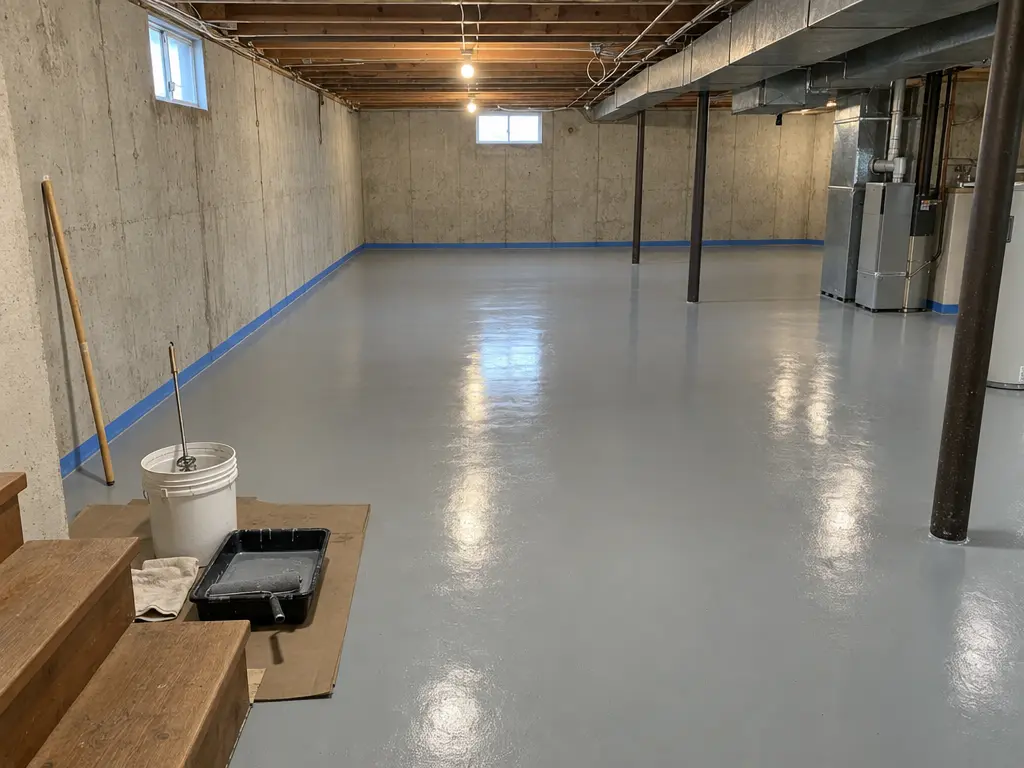 A fresh coat on a basement slab
Calcium chloride test
We measure vapor emission using ASTM F1869, in pounds per 1,000 square feet per 24 hours. If 3lbs or higher, a dampness reducing primer is required.
In-slab humidity probes
For ASTM F2170, we place probes in holes drilled to 40% of the slab depth to measure the internal dampness.
Grinding off the old finish
We remove peeling old paint, carpet adhesive and old sealant using a diamond grinder with a vacuum to contain the dust.
Walls, drains and cracks
We check for water staining, white powder and dampness in the following places before choosing a primer: at the wall line, floor drainage and in all cracks.
A hand check for blush
Between June and September, 6am temperatures at KCI are typically less than 5F above dew point, and average dew point in July is 67F (NOAA). In cold, damp curing conditions, amine blush may form, a waxy layer which causes coatings to fail to adhere. We will feel for this and wash it off.
Cure check before we go
We will tell you when foot traffic and furniture can be placed on the floor, and what to keep off it while it cures.
Concrete paint and an epoxy coating, side by side
Paint and epoxy both go onto basement concrete. Paint forms a thin layer on top of the concrete. Epoxy cures into a thick layer that adheres to the suitably ground concrete.
| Basement slab | Concrete paint | Epoxy coating |
|---|---|---|
| Where it sits | A thin film resting on top of the bare slab | Bonded into a ground, open concrete surface |
| How it works | Dries as the water or solvent leaves the film | Two parts react and cure into a hard, thick layer |
| Usually found on | Storage corners and low-use utility rooms | Rec rooms, workshops, laundry areas and finished basements |
| What failure looks like | Blisters and peeling where moisture pushes up through the slab | Lifting where the slab was damp or never ground |
| What a safe repair needs | Scraping and grinding every loose flake of paint off | A moisture test, plus a mitigation primer if it reads high |
Signs an Independence basement floor needs work
- Patches of peeling paint, often along walls.
- White powdery residue on concrete (residue returns after sweeping).
- Dark damp patches (after heavy rain) or musty smell near floor.
- Dust from concrete on stored items.
- Old carpet adhesive or tiles to be removed.
If 2 or more of these apply, give us a call. We can test the concrete and discuss what color(s) to use.
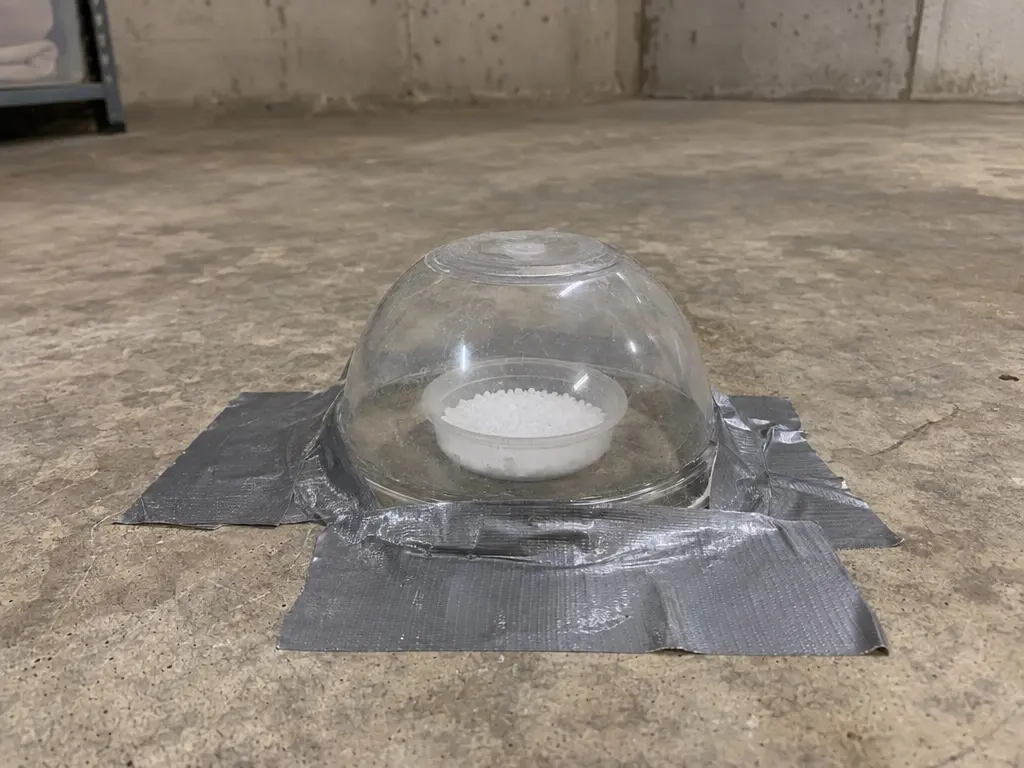 Moisture test on a basement slab
Basement floor questions we hear
Most basements will correspond to these. If not, give us a call.
Do you seal basement floors?
Yes. If you want a natural look on dry concrete, a penetrating sealer is a great value solution: it is breathable and will stop dust. If you want a wipeable floor, we can apply a coating.
In general applying a coating to existing concrete is considered finishing work. However, finishing a basement in Independence requires a permit from the city. Please check with the city to see if a permit is required if this floor is part of wider finishing work.
What is the best coating for basement floors?
If it is a used basement, we recommend applying an epoxy coating to ground and tested concrete. Depending on dampness results, we may apply a dampness reducing primer before applying the epoxy.
Depending on the room, we can apply solid colors, flake or clear coatings. If applying paint or thin store kits to slabs with moisture coming up, this is the worst option.
Is it worth it to epoxy a basement floor?
Basement floor epoxy is a worthwhile investment if the concrete passes a dampness test or fails but you are happy to include the dampness reducing primer. It will mean no dust falling from the floor, easy to wipe and brighten up a dull basement.
However, it is not a worthwhile investment on an active leak. Leaks should be fixed first. No coating will prevent water entering.
Is it better to paint or epoxy a basement floor?
Epoxy is ideal for a floor that is walked on every day. Although cheaper, paint is only suitable for storage areas. It is very thin and will blister where moisture is coming up from the floor.
Epoxy will cure to a thick layer that adheres to suitably ground concrete. Whatever option we choose, we must always test first. If the calcium chloride test shows 3lbs or more, we must apply a dampness reducing primer underneath the coating.
Tell us about your basement floor
Please tell us approximate size, current contents, if water has entered from outside and what the room is used for to help us give you the right coating.
(816) 325-3549Open Monday to Saturday, 7am to 7pm