
Polished concrete floors in Independence
Polished concrete floors have been ground using progressively finer diamond discs to give a shiny surface. As there is nothing sealed or peeling on top, we can polish shops, retail spaces and basements in Independence, Blue Springs, Raytown and Sugar Creek.
Ground and polished slabs
Before we come: Let us know about existing adhesive, paint, sealant and tile. We must remove all existing materials to expose bare concrete.
Quick answer
How to look after polished concrete floors?
Dust mop regularly. To wet mop, use a neutral cleaner. As grit can cause dullness in a polished floor, a welcome mat at the entrance and dry mopping will help most. Spills of red wine, vinegar, citrus and pop should be wiped up quickly, as acidic liquids may cause etching. Don’t use wax, bleach or harsh degreasing products. There are no coatings on the surface to strip or re-apply. In heavily used areas, the high traffic areas may become slightly dull over time. A machine burnish or light re-polish with new densifier will restore this.
What a polishing job includes
We start with coarse diamond grinding to remove the worn surface and reveal the stone within the slab. This creates a durable floor.
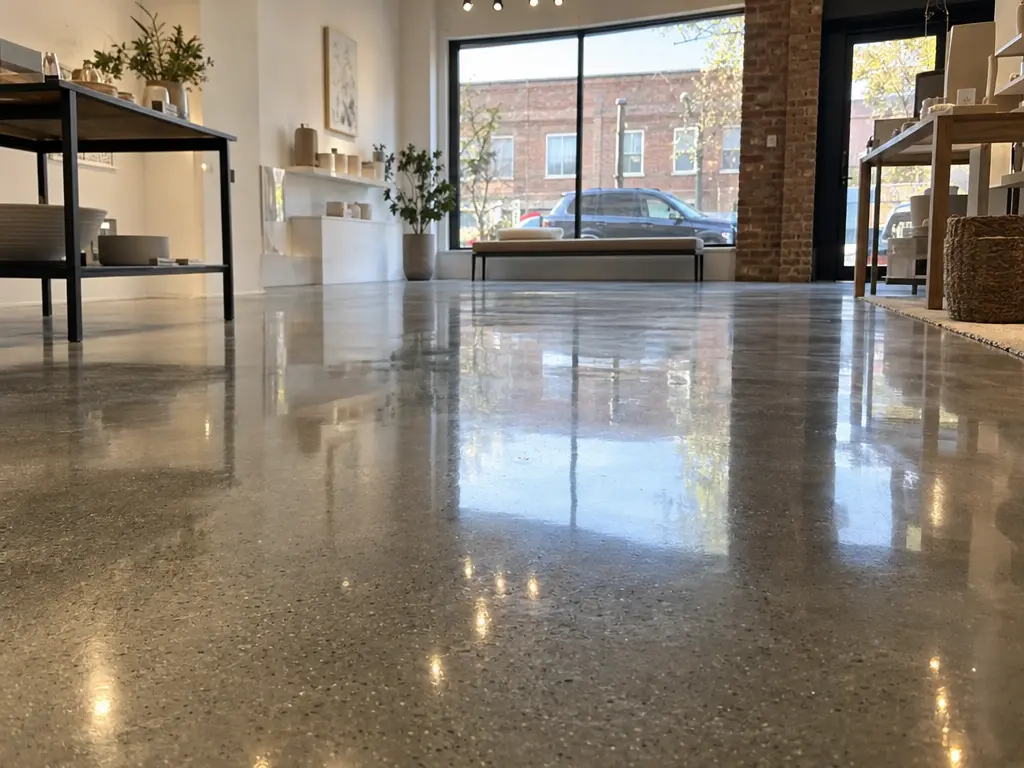 Polished showroom floor
Stripping to bare concrete
As the diamonds need to cut cleanly into the stone and the densifier needs to penetrate the surface, we remove all adhesive, paint, old sealant and tile mastics.
Coarse to fine grinding
We use progressively finer diamonds in order to achieve the desired finish, from a flat surface to a highly reflective surface where you can read signs.
Lithium silicate densifier
The product soaks into the surface. Inside the concrete, it strengthens the surface to prevent gray dust being released.
Cracks, patches and saw cuts
We inspect all cracks, repairs and saw cuts. As polishing reveals what is in the slab, we will clearly let you know what will be visible in the finish and what should be repaired.
Gloss read by eye
We lie on the floor to check that the lighting from the ceiling is creating a clear and even reflection with no hazy or swirly patterns.
Wet slip resistance
In testing by CPC and TCNA, polished concrete achieved the wet slip resistance threshold of 0.42 DCOF (ANSI A137.1 standard) even at a very high gloss. This is useful in wet entrance areas.
Mechanical polish compared with grind-and-seal
A mechanical polish continues grinding until a glossy surface is achieved. With grind and seal, less grinding is carried out and a topical sealant is applied to create the glossy finish.
| What to weigh | Mechanical polish | Grind-and-seal |
|---|---|---|
| Where the shine sits | In the concrete itself, refined by progressively finer diamonds | In a sealer film rolled on over a ground slab |
| How it works | Many grinding passes plus a densifier that hardens and dust-proofs the surface | Fewer, coarser passes, with an acrylic, urethane or epoxy sealer on top |
| Usually found on | Retail floors, showrooms, warehouses and finished basements with sound slabs | Floors where a lower spend up front matters more than upkeep later |
| How it wears | Walking lanes slowly lose some gloss; nothing peels or flakes off | The sealer scuffs and wears through along the traffic paths |
| Upkeep it needs | Dust mop, neutral cleaner, and an occasional burnish or light re-polish | Stripping and recoating the sealer whenever it wears thin |
Signs that your slab is a good fit for polishing
- Dusting of gray particles onto boxes, shelving, shoes and any items in storage.
- Peeling of paint/coating. You’re no longer wishing to re-coat.
- High foot traffic in shops/showrooms/storefronts throughout the day. Swept nightly.
- Like the concrete aesthetic.
- No large cracks, crumbly areas or weak areas.
If 2+ of these points apply to your floor (anywhere in Independence), please get in touch.
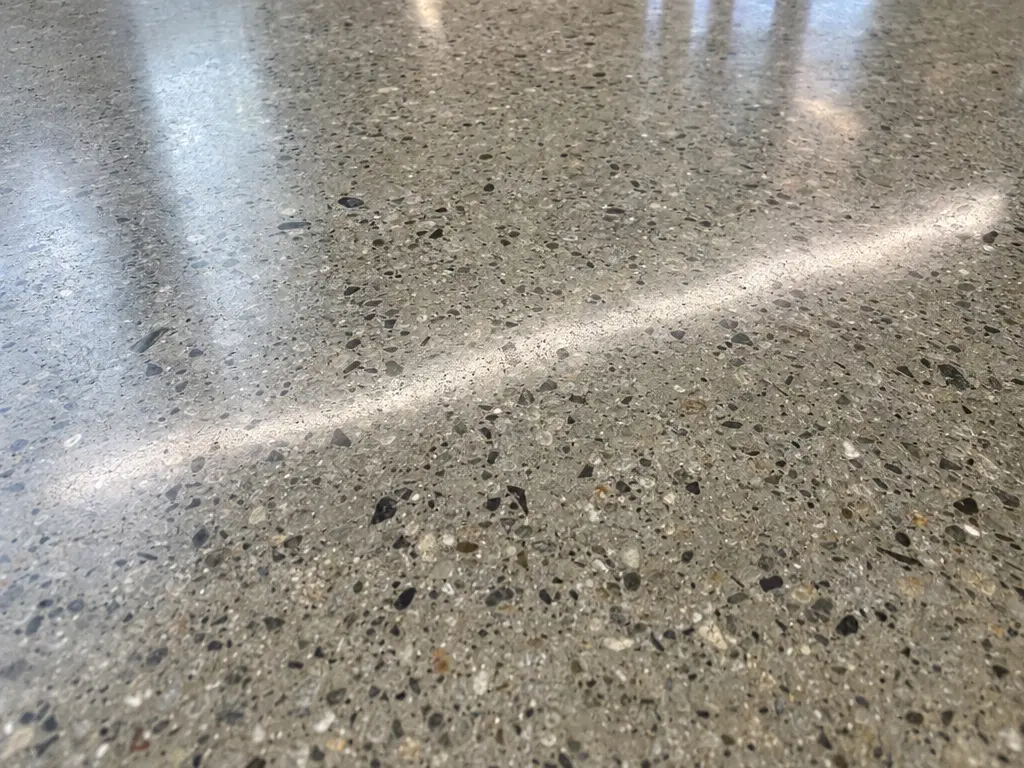 Aggregate up close
Common calls about polished floors
If you have a question we haven’t covered, please get in touch.
What is a cheaper alternative to polished concrete?
Grind and seal. Fewer passes of grinding are carried out and a topical sealant is applied. The gloss is coming from the sealant.
This option is cheaper, however, in high traffic areas, the sealant will wear and will need to be reapplied occasionally. True concrete polishing will never require this. Another cheaper option may be to densify and seal the slab well.
Call us about the slab you have
Let us know the room size, purpose of the room, current flooring and any cracks/repairs known. We can let you know if this can be polished.
(816) 325-3549Open Monday to Saturday, 7am to 7pm