
Commercial epoxy flooring in Independence
Commercial epoxy flooring in areas such as workshops, warehouses, clinics and restaurants. We tailor the system to the conditions in each room to no longer have dusty concrete, worn paint and stubborn stains in Independence, Blue Springs, Raytown and Sugar Creek.
Shop, warehouse, kitchen
Before we come: Please let us know what is spilled or driven over. Different products (fork-lifts, hot oils, solvents) will mean different systems.
Quick answer
Are epoxy floors good for restaurants?
Yes in dining areas, restrooms, storage and dry preparation areas. No in hot lines. Thin epoxies may crack in thermal shock from changing temperatures from hot oils/frying temperatures to icy/cold rinses. In the cooking line we recommend cementitious urethane (Urethane Mortar). This creates a heavy duty floor that flexes with the concrete. From the data sheets of BASF and Sika, a 6mm urethane mortar floor can resist spills up to 80C (176F) and freezing temperatures as low as -25C (-13F). In many kitchens, both systems are used. Urethane mortar in the back and epoxy in the front.
What a commercial floor job includes
Depending on the room, the finish will vary. The preparation work completed (grinding, filling cracks and joints) on shop/warehouse floors in Independence will determine how long the finish lasts.
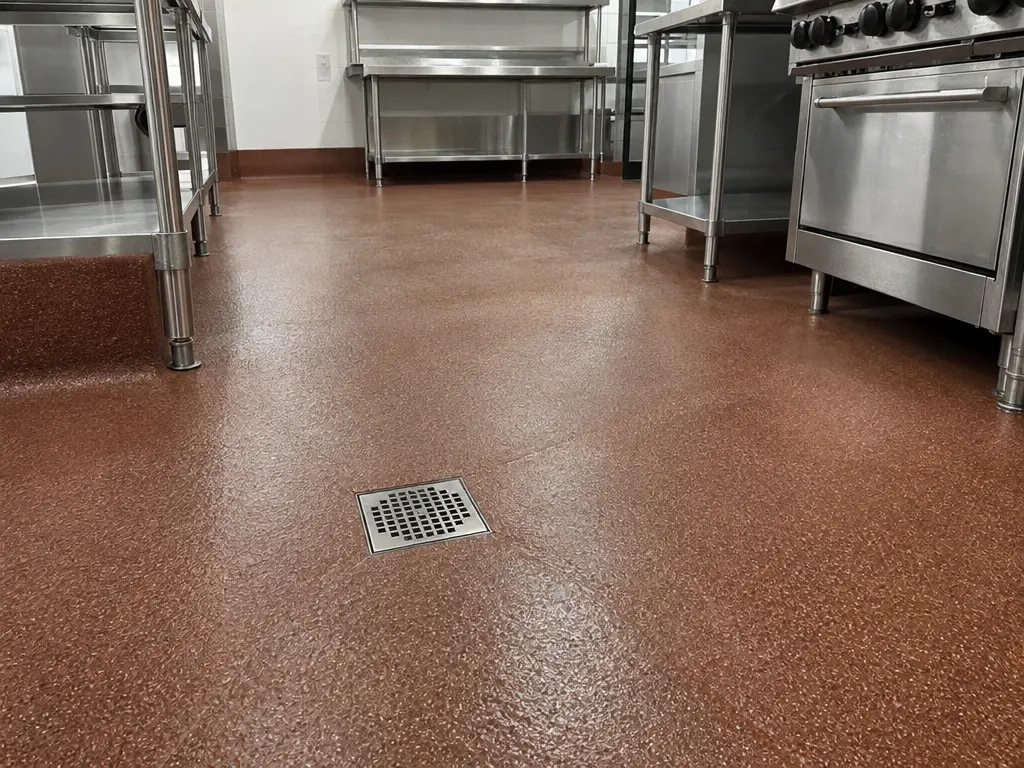 Kitchen floor with a drain
Grinding or shot blasting
The strength of a warehouse floor coating depends on the quality of the concrete. We grind off curing compound, oil and old paint until we reach clean, open concrete for the resin to bond to.
Cracks and control joints
We fill static cracks and control joints level during preparation. We give moving joints a flexible joint and never bridge them.
Cove base at the walls
If the floor is washed, we apply the coating 2 to 6 inches up the wall to create one smooth wipeable edge with no corner joint.
Drains, docks and racks
We will check floor drains, dock doors, racked item foundations and machine foundations to make sure the coating can finish cleanly or work around fixed equipment.
Build and finish check
We will check the build throughout the floor, for pin holes, thin areas and dull areas under lighting.
Slip finish and lane lines
In wet areas, we will create a more grippy finish. We can mark out aisles/safety lanes as required.
Epoxy compared with urethane mortar
In dry areas, aisles and showrooms, epoxy is ideal. In hot, steamed and regularly washed areas (where thin epoxy may crack), urethane mortars are ideal.
| What to weigh | Epoxy system | Urethane mortar |
|---|---|---|
| Best rooms | Warehouses, showrooms, clinic halls, dining rooms and dry storage | Cook lines, dish rooms, walk-in thresholds and washdown areas |
| How it works | Resin coats built up over a ground slab and sealed with a hard topcoat | A thick cement and urethane mortar troweled onto the slab, with thermal movement close to concrete |
| Usually found on | Forklift aisles, retail floors, school and clinic hallways | Restaurant kitchens, food plants and drink bottling floors |
| What goes wrong | Cracks and lets go under hot oil, steam or boiling water | It yellows in direct sun, so it stays indoors |
| What the slab needs | Clean ground concrete, filled cracks and joints handled at prep | Sound concrete, no epoxy moisture barrier under it, and a cove base |
Signs your commercial floor needs redoing
- Gray dust on stock, shelving and machines. Dust appears again within a day of sweeping.
- Peeling paint/old coating in forklift areas and at dock doors.
- Cracked tiles and grouting in kitchen with greasy odor.
- Hard to remove stains no matter how hard staff scrub.
- Slick floors near sinks and drainage.
If 2 or more of these apply please give us a call. Let us know how big the room is (in square feet) and what it is used for all day, no matter where in Independence.
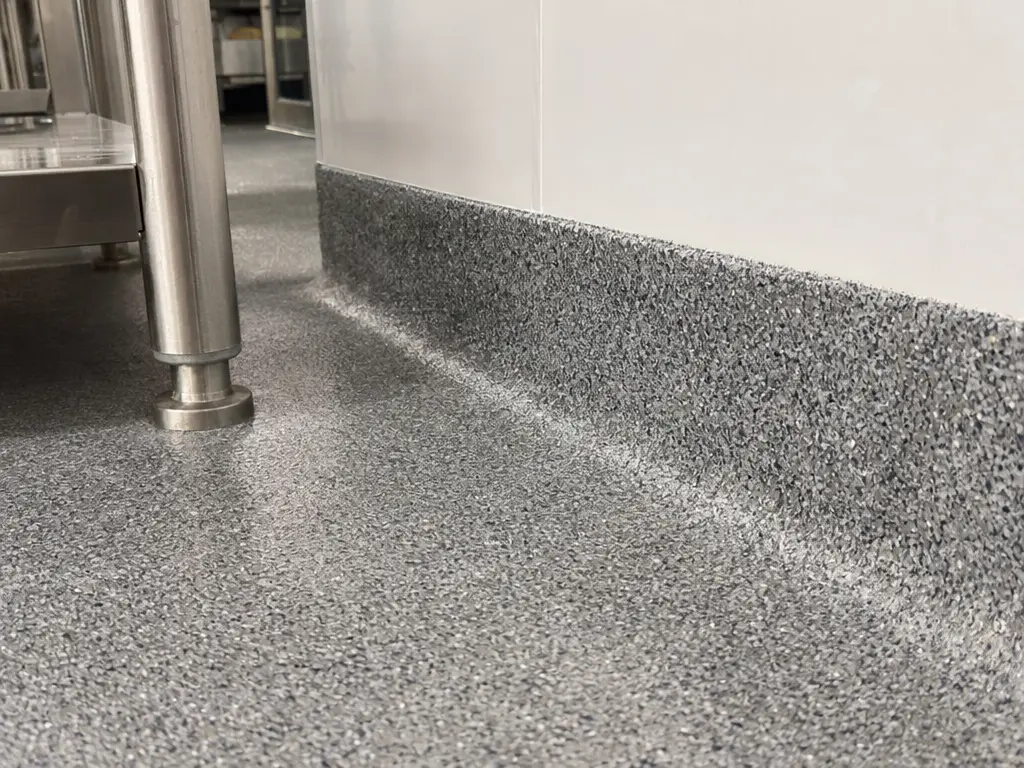 Cove base at the wall
Questions owners ask about commercial floors
Most commercial requests relate to these. If not, give us a call.
How much does it cost to epoxy a commercial floor?
More dependent on the room than the resin. While square footage will determine a base price, the main difference comes from the condition of the concrete. Curing compound, oil and old paint to be removed, cracks and joints to be filled and how far the cove base goes up the walls all affect the price.
The system required will also affect the price. Thin coatings in stock rooms will be cheaper than high build shop floor epoxy in busier repair bays. Give us a call with the size and use.
What is the best epoxy for commercial floors?
Appropriate system for the room. In aisles and production areas, industrial epoxy flooring with a tough top coating (urethane or polyaspartic) in a high build epoxy will be the best choice. If acids or solvents are present in the room, novolac epoxy will be more durable than standard epoxy.
In showrooms, we can apply metallic for aesthetic appeal. In hot kitchen lines, no epoxy should be used. Urethane mortar is ideal as it can handle the heat and washing.
Tell us what your floor goes through
Let us know how big the room is (square feet), what it is used for, what is being spilled/driven over and which areas must remain open while we work. We can advise you if commercial epoxy flooring or urethane mortar is the right choice for your room.
(816) 325-3549Open Monday to Saturday, 7am to 7pm