
From the blog
When an Epoxy Garage Floor Pays Off in Independence
Updated
Quick answer
Is it worth it to epoxy your garage floor?
Yes. If done correctly and in suitable weather conditions. If the floor has been prepared well, with a high build epoxy base beneath a durable topcoat, you will avoid issues with slushy salt, oil spills and bringing in dusty concrete particles. However, an epoxy garage floor should not be used on damp concrete, peeling store applied coatings (that have not been ground off) or on humid mornings in summer. The majority of issues with garage coatings occur due to poor preparation or unsuitable weather conditions, rather than resins.
This is often asked at garages in Independence. While product choice has some influence, slab condition has much more influence. Below we have listed common issues, when garage coatings fail, what to consider, and how local weather patterns affect suitability.
If your situation matches an issue in the left column, consider if the problem can be resolved by you or by an installer in the right column.
| What you notice | Likely cause | Who should handle it |
|---|---|---|
| Coating lifting where the tires park | Hot tires softening a thin or under-cured film, then lifting it | Your installer |
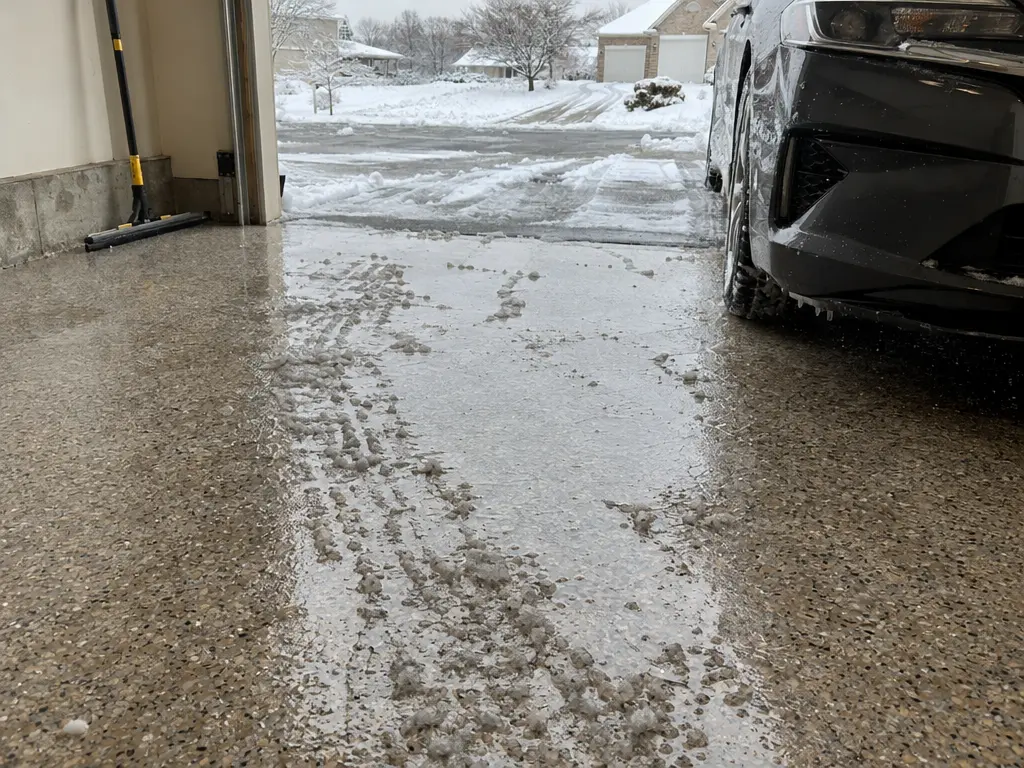
| White crust by the door all winter | Road salt and slush drying on the surface between washes | You, with a damp mop |
| Small bubbles or pinholes in the finish | Air escaping a warming slab while the coat was still curing | Your installer |
| Store-bought kit peeling in sheets | A thin film rolled onto a slab nobody ground open | Your installer, to grind it off |
What are the downsides of an epoxy garage floor?
Glossy garage coatings will be slippery when wet; if using a grit filled topcoat, this issue can be avoided. During installation (and curing) the garage must be empty. Lastly, patch repairs will never be completely invisible, so the initial installation must be done correctly.
Hot tire pickup is a major issue. If tires have been driven over a hot road in summer, they will be hot enough to soften a thin coating, and as the tire cools, it will grip and pull up the coating. A durable top coat over a well-ground high build base avoids this issue.
Most garage coatings fail at the prep or the weather
Coating failures in garage floors rarely come from the resin. Usually the cause is poor preparation: an unground surface, oil residues in pores or applying the coating when the slab was within 5F of the dew point (per the application guide by Euclid Chemical). This causes moisture to be trapped beneath the coating.
Worth knowing
To allow good adhesion, the surface must be coarse and open. A diamond grinder is required to get this finish on a garage floor. If not ground correctly, even the best resin product will not adhere to the smooth surface.
On all our garage floors in Independence, we grind the floor, remove oil from stains and fill cracks. On the day of installation we will check the temperature of the surface of the slab against the dew point. If these are too similar, we will delay installation.
What to ask an installer before you book
Some of these checks can be conducted easily this week; others require equipment. Any installers in Independence should be able to explain how they handle these. Please see our FAQ page for cost questions, and our basement floor page for damp sub-grade floors.
Checks you can do
- Place a square of plastic on the floor and leave overnight, then check for moisture underneath.
- Spray with water. If it becomes darker and absorbs water, the slab is unsealed.
- Note oil stains, cracks and old paint/kit.
- Measure the floor and take a picture in daylight with the garage door open.
Leave for the installer
- Diamond grind the whole floor, including edges. Collect dust.
- Grind old kit/paint/sealer back to clean concrete.
- Check temperature of slab against dewpoint.
- Apply base, flake and top coat within working times.
How Independence summers and winters change the answer
Mornings in summer months are problematic in Independence. Between June and September, at the primary airport station in the region, NOAA's normal difference between air temperature and dew point at 6am is less than 5F. July's normal low sits in the upper 60s, while the average dew point is 67F.
Garage coatings in Independence have been installed most easily in mid April to early June and mid September to late October. December to February is very difficult: cold slabs, slower curing and salt already on the floor. If installation is carried out within the easier periods, a successful epoxy garage floor is more likely.